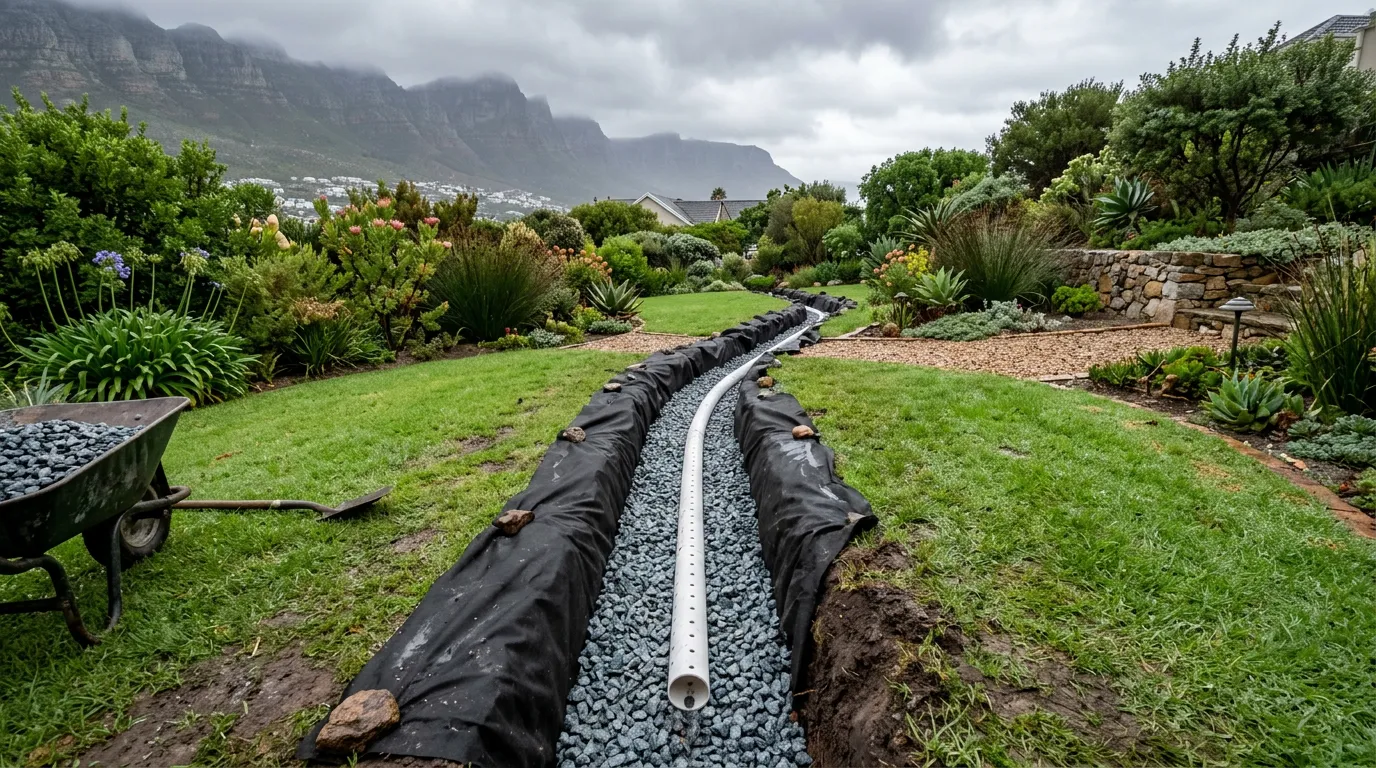
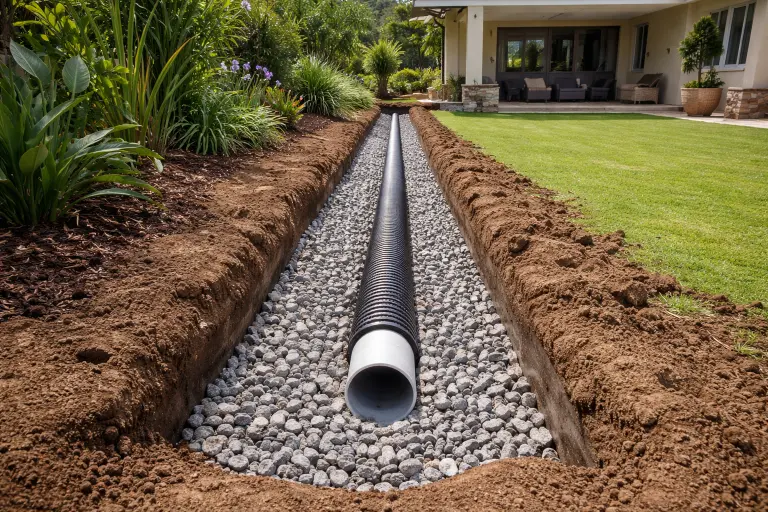
A French drain is a gravel-filled trench with a perforated pipe that redirects groundwater and surface water away from your property. If your garden turns into a swamp every Cape Town winter, your walls have rising damp, or water pools against your foundation after rain, a French drain is almost certainly the fix you need.
We install French drains across the Western Cape, and the single most common question we get is: "What will it cost?" The short answer is R450 to R950 per metre, fully installed. The longer answer depends on your soil, the depth required, and how accessible your property is.
| Question | Answer |
|---|---|
| How much does a French drain cost? | R450 – R950 per metre installed |
| How long does installation take? | 1–3 days for a typical residential property (15–30m) |
| Do I need municipal approval? | Usually no for standard residential, yes if connecting to municipal stormwater |
| How deep should a French drain be? | 300mm–600mm for surface water; up to 1.2m for foundation protection |
| Best time to install in Cape Town? | Late summer/autumn (Feb–April) before the winter rains |
What Does a French Drain Cost in Cape Town?
| Component | Cost Range | Notes |
|---|---|---|
| Standard French drain | R450 – R650/m | 300–450mm deep, sandy soil |
| Deep French drain | R650 – R950/m | 600mm–1.2m deep, foundation protection |
| 110mm perforated pipe | R45 – R75/m | PVC or HDPE, geotextile-wrapped |
| 19mm drainage stone | R550 – R750/m³ | Delivered price varies by area |
| Geotextile fabric | R25 – R45/m² | Prevents soil migration into gravel |
| Labour | R200 – R400/m | Higher for clay or rocky soil |
| Typical 20m residential job | R9,000 – R19,000 | All-inclusive estimate |
When Do You Need a French Drain?
Cape Town receives 500–600mm of rainfall annually, nearly all between May and September. Signs you need one:
- Standing water in your garden that takes more than 24 hours to drain after rain
- Rising damp on interior walls, particularly ground-floor rooms against sloped ground
- Water pooling against your foundation or seeping into a garage
- Soggy, waterlogged lawn that stays muddy well into spring
- Retaining wall failure caused by hydrostatic pressure
If any of these sound familiar, a French drain is one of the most cost-effective drainage services available. It works passively with gravity — no pumps, no electricity, no moving parts.
How French Drain Installation Works
- Site assessment: We check gradient, soil type, existing drainage, and where water collects.
- Excavation: Trench route marked (300–450mm wide), excavated with consistent fall of at least 1:100.
- Geotextile lining: Trench lined with geotextile fabric to prevent silting.
- Pipe and gravel: 110mm perforated pipe laid at base, surrounded with 19mm drainage stone.
- Backfill: Trench backfilled with soil and compacted.
- Discharge: Drain exits into a soakaway pit or connects to stormwater system.
Frequently Asked Questions
How long does a French drain last?
A properly installed French drain with geotextile fabric lasts 15–25 years in Cape Town conditions. Without geotextile, expect 3–5 years before clogging. We recommend inspection every 2–3 years.
Can a French drain solve rising damp?
Yes, in most cases. Rising damp is frequently caused by a high water table or poor drainage around the foundation. A French drain at foundation depth intercepts groundwater before it reaches the wall.
What's the difference between a French drain and a channel drain?
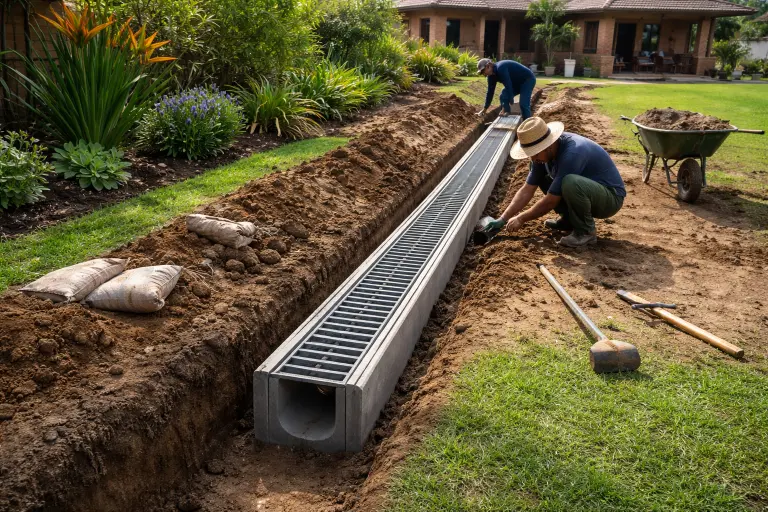
A channel drain collects surface water only. A French drain is buried underground and collects both surface and sub-surface water through a perforated pipe surrounded by gravel. For waterlogged gardens and foundation protection, French drain is the right choice.
Do I need a French drain if I already have gutters?
Gutters handle roof water only. If your downpipes discharge onto the ground near your foundation, a French drain can intercept that water and move it away. Ideally, downpipes should connect to your stormwater system.
Need a French Drain in Cape Town?
Abacas Solution installs french drains and stormwater systems across the Western Cape. Free site assessment.
Get a Free Quote Call 067 071 9472