If your old electric geyser is chewing through power and you are worried about burst cylinders flooding your ceiling, the IHP (Integrated Heat Pump) “burst-proof” geyser is the game changer to look at in 2026, with tests showing it can cut water heating costs by up to 85% compared to a standard electric geyser on a 200 litre system.
Key Takeaways
What is an IHP “burst-proof” integrated heat pump geyser?
It is a stainless steel, integrated heat pump geyser that heats water very efficiently and is designed to be no-leak and no-burst, ideal for Cape Town properties.
How much can I save on electricity in Cape Town?
Households typically save up to 85% on water heating, which can equate to around R2 200 per month, depending on usage and tariffs.
What does an integrated heat pump geyser cost in South Africa in 2026?
Indicative pricing for a 200 L IHP unit is around R24 500 for the unit or about R30 000 including installation, with 300 L options around R35 000 installed.
Can I install an IHP geyser in an existing home in Cape Town?
Yes, our team handles full geyser installation in Cape Town, including pipework, valves, and drip trays.
Is it really “burst-proof”?
The design uses stainless steel, IP68 waterproofing, and a no-leak, no-burst concept, supported by a 10 year warranty from the manufacturer.
Who can install and maintain it?
You need licensed plumbers and electricians. We provide geyser and water heater services across Cape Town and the Western Cape.
1. What Makes The IHP “Burst-Proof” Integrated Heat Pump Geyser Different?
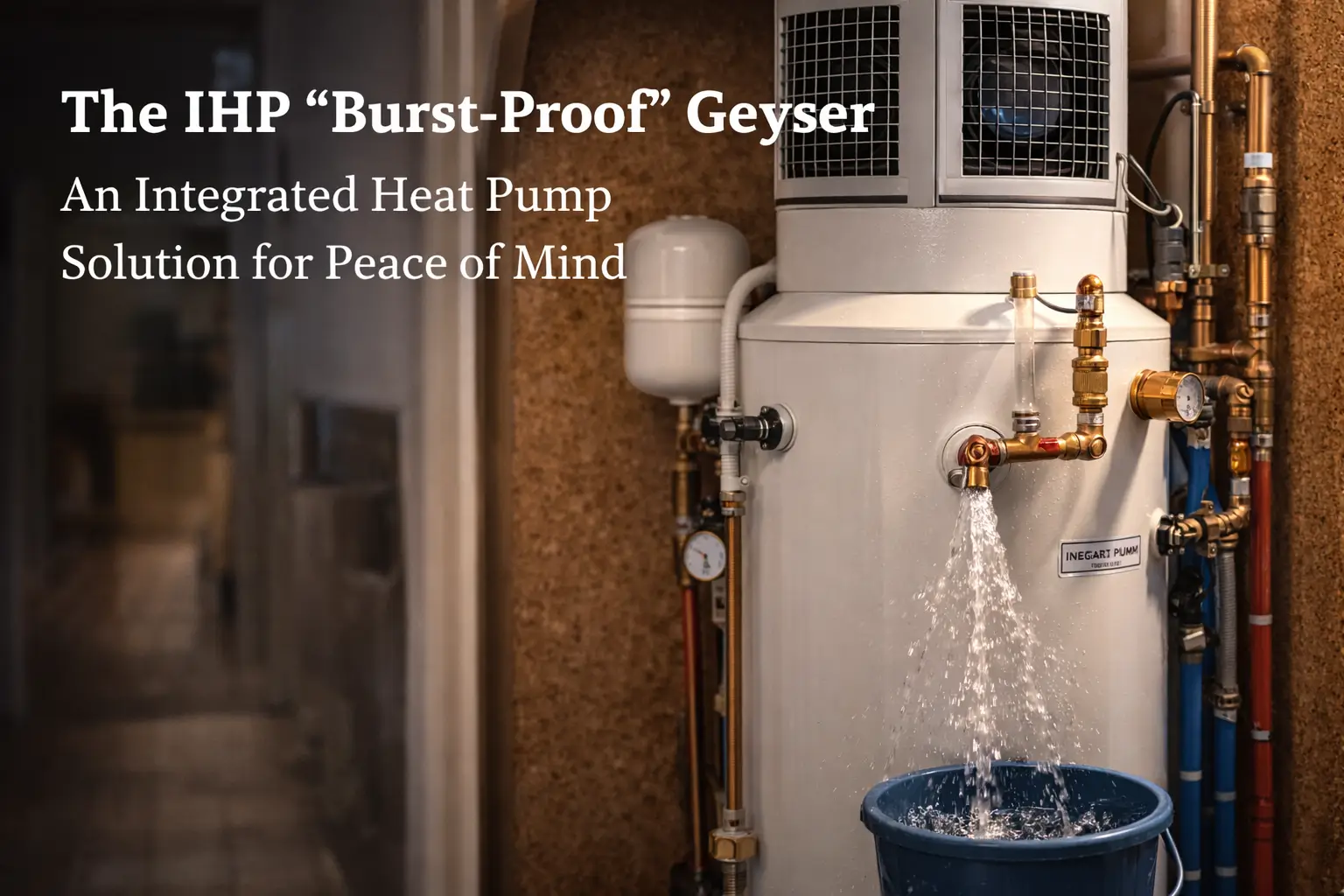
The IHP integrated heat pump geyser is not a normal electric cylinder with a probe stuck in the side. It is a purpose-built unit that combines a heat pump, storage tank, controls, and safety devices into one compact system.
The “burst-proof” aspect refers to its stainless steel tank, high-quality welds, and pressure control strategy that aim to eliminate those sudden ceiling floods many Cape Town homeowners know too well.
Key design features that matter in Cape Town homes
For local properties, especially older houses in areas like Rondebosch, Claremont, or the City Bowl, ceiling space is tight and access is awkward. The IHP’s compact footprint and floor-mounted or wall-adjacent positioning give us more flexibility than a bulky horizontal cylinder.
The IP68 waterproofing on critical components and the stainless steel body also handle the coastal air better than mild steel cylinders, which helps reduce corrosion issues in the long term.
How the integrated heat pump works compared to a normal element
A conventional 150 litre electric geyser usually runs a 3.0 to 3.5 kW element that chews electricity every time someone showers. The IHP uses a heat pump that draws roughly 0.6 kW for a 200 litre unit, and then slowly and efficiently moves heat from the ambient air into the water.
The unit can heat water up to about 75 °C, which means even though a 200 litre tank sounds similar to your old geyser, you effectively get more usable hot water once it is mixed down to safe tap temperatures.
2. Integrated Heat Pump Geyser South Africa: Why It Matters In 2026
In 2026, Eskom tariffs and municipal increases in Cape Town keep climbing, and water heating is still one of the biggest loads on a household’s bill. An integrated heat pump geyser in South Africa is becoming less of a luxury and more of a practical way to survive monthly costs.
For landlords and body corporates managing blocks in areas like Sea Point, Observatory, or Blouberg, the IHP model also reduces the constant call-outs and ceiling damage linked to burst cylinders and ageing valves.
How the IHP fits the South African grid reality
A standard geyser pulls big current over short bursts. This hits the grid hard during peak times, especially when everyone cooks and showers at the same time.
The IHP’s 0.6 kW draw smooths that demand and is light enough that even homes with modest solar and battery systems can keep water heating in the mix during higher stages of load shedding.
Why Cape Town homes benefit specifically
Cape Town’s coastal climate means cooler incoming water in winter and higher humidity. The heat pump thrives in those conditions compared to inland regions with extreme cold.
We also deal with many older copper and galvanised pipe systems, so combining an IHP upgrade with targeted leaks and pipe repairs gives a long-term fix instead of another “band‑aid” on a 20 year old geyser.
3. Burst-Proof Design: No-Leak, No-Burst Construction And Why It Matters
When a traditional geyser bursts in a ceiling in Tamboerskloof or Durbanville, you are looking at soaked insulation, damaged ceilings, ruined cupboards, and sometimes electrical hazards. The IHP’s no-leak, no-burst stainless steel construction is designed to remove that risk as far as possible.
The tank is stainless steel, the seams are carefully welded, and the unit is IP68 rated for waterproofing, which is a major step up from thin mild steel cylinders that rust from the inside out.
10 year warranty and practical peace of mind
Manufacturers back the IHP burst-proof geyser with a 10 year warranty on the cylinder. That tells you there is serious confidence in the design and materials.
For Cape Town property investors, that warranty lines up well with typical holding periods for rental units, which means fewer mid-lease geyser failures and emergency repairs.
How burst-proof helps with insurance and CoC
Insurers in 2026 are more sensitive about water damage claims than ever. Installing a burst-proof geyser with the right drip tray, overflow route, and pressure control can help avoid premium hikes and claim disputes.
When we handle a geyser upgrade along with electrical compliance checks, we make sure the wiring, isolators, and bonding all line up with current SANS standards for a straightforward CoC process.
Did You Know?
No-leak, no-burst IHP geysers use stainless steel construction with IP68 waterproofing and are backed by a 10 year warranty, directly tackling one of the biggest worries Cape Town homeowners have about geysers.
4. Energy Efficiency: How The IHP Cuts Geyser Running Costs
An integrated heat pump geyser in South Africa only makes sense if it actually delivers lower running costs. The IHP’s 200 litre model uses about 1.78 kWh per day on average, which is a fraction of what a standard electric geyser draws.
That translates into estimated running costs of roughly R7.12 per day, depending on your tariff, which is a lot less than the typical R900 to R1 500 many Cape Town households see every month just from electric water heating.
Power draw compared to a standard 150 L geyser
A conventional 150 litre electric geyser pulls around 3.5 kW when the element is on. The 200 litre IHP unit sits at roughly 0.6 kW, which is gentle enough that it can run even when other big appliances are active.
This lower draw is also friendlier to small inverters and backup systems, which matters for properties where we have already installed solar and backup power solutions.
Realistic savings and payback period
When you combine the 85% reduction in water-heating energy with Cape Town’s 2026 tariffs, the numbers are compelling. Typical households see around R26 000 in first year savings from a 200 litre IHP compared to their old electric geyser usage pattern.
That lines up with a payback period of around 1 to 2 years, after which the lower monthly bill is effectively money back into your pocket.
Three key benefits of the IHP Burst-Proof Geyser are highlighted in this infographic. Learn how it improves energy efficiency, reliability, and rapid heating for your home.
5. Integrated Heat Pump Geyser South Africa Prices In 2026
When people call us about an integrated heat pump geyser in South Africa, the first question is usually price. Current industry data in 2026 puts a 200 litre IHP unit at around R24 500 for the hardware and about R30 000 including professional installation.
A larger integrated heat pump geyser 300L option typically lands around R35 000 installed, which suits bigger families or small guesthouses that need more continuous hot water.
Comparing sizes: Integrated heat pump geyser 200L vs 300L
The 200 litre IHP suits most three bedroom homes, with a couple of showers and a standard kitchen usage pattern. It already offers about 50 litres more usable hot water than a standard 150 litre electric geyser because of higher storage temperature.
The integrated heat pump geyser 300L is ideal if you have three bathrooms, a busy household, or run a small Airbnb where morning peak usage is brutal on older systems.
Integrated heat pump geyser 200L
Standard family home, 1 to 2 bathrooms
~R30 000
Integrated heat pump geyser 300L
Larger home, 3+ bathrooms or light commercial
~R35 000
Integrated heat pump geyser South Africa cost vs savings
If you are paying around R1 500 per month on water heating with a standard electric geyser, and you cut that by roughly 85%, your annual saving could sit around R26 000 or more. Suddenly the integrated heat pump geyser South Africa cost does not look so steep.
Finance options, such as asset finance over 48 months or “hot-water-as-a-service” packages, are now common in 2026 through major banks, which makes the upfront spend easier to manage.
6. IHP vs Kwikot Integrated Heat Pump Geyser And Other Brands
Homeowners often ask us whether the IHP is really the best integrated heat pump geyser South Africa has in 2026 or if brands like Kwikot are still the safer choice. Kwikot has a long track record, especially with standard electric and some heat pump solutions.
The IHP stands out because it is a fully integrated unit with a burst-proof stainless steel tank and ultra-low power draw, rather than a retrofitted external heat pump onto a conventional cylinder.
Kwitkot integrated heat pump geyser comparison
A Kwikot integrated heat pump geyser is usually a solid, SABS-compliant product that many plumbers are familiar with. It is often a cylinder plus an attached or nearby heat pump unit.
The IHP’s engineering focus is on efficiency and “no-leak, no-burst” design with a higher operating temperature, which gives it an edge where long-term reliability and savings are the priority.
Where each type fits best
If you have an existing Kwikot cylinder in good condition, a retrofit heat pump might be a practical short term step. For new builds, major renovations, or serious bill reduction, we see more clients opting for a full IHP integrated system in 2026.
Our job is to assess your current setup and then recommend either like-for-like replacement, a Kwikot integrated heat pump solution, or a full IHP installation based on your budget and future plans.
7. Best Integrated Heat Pump Geyser South Africa: How We Assess “Best”
When we talk about the best integrated heat pump geyser South Africa offers in 2026, we are not just looking at glossy brochures. We look at failure rates, call-back numbers, energy performance, and how the unit behaves after a few Cape winters.
The IHP integrated heat pump geyser scores high in all those areas, which is why we increasingly recommend it when clients want both efficiency and reliability over the next decade.
What we check before calling a geyser “best”
We assess cylinder material, warranty period, compressor reliability, noise levels, backup elements, and how the controls manage Legionella risk at higher storage temperatures. We also consider how the geyser integrates with existing plumbing and electrical layouts.
The IHP setup includes a 2 kW backup element for rapid heating when necessary, plus user-friendly controls that keep operation straightforward for tenants and owners.
When another brand might still be the right call
If your budget is tight and your current cylinder is fairly new, a simpler retrofitted heat pump or a mid-range integrated unit might make sense. In complexes with strict architectural constraints, the physical size and look of the unit also play a role.
We always start with a site visit, then give you a clear, written recommendation with a breakdown of the integrated heat pump geyser South Africa prices that apply to your case.
Did You Know?
Typical break-even time for an IHP integrated heat pump geyser is only 1 to 2 years, with many South African households saving about R2 200 per month on electricity costs related to hot water.
8. Realistic Integrated Heat Pump Geyser South Africa Cost Of Ownership
Upfront integrated heat pump geyser South Africa prices only tell half the story. We encourage clients to look at total cost of ownership, including maintenance, replacement risk, and energy spend over 10 years.
A conventional geyser might be cheaper on day one, but once you factor in two or three element changes, anode replacements, and a burst event, the numbers shift quickly.
Running costs over 10 years
If your IHP geyser costs around R7.12 per day to run, that is roughly R2 600 per year at current tariffs. A standard electric geyser can easily double or triple that figure.
Over 10 years, the difference can reach R100 000 or more in avoided electricity and damage costs, especially once you account for future tariff increases in Cape Town.
Maintenance and servicing in Cape Town conditions
Stainless steel construction and IP68 waterproofing mean less corrosion and fewer leaks. You are not dealing with regular cylinder replacements like older mild steel units in coastal air.
We still recommend periodic checks on pressure control valves, safety valves, and electrical connections, which we handle as part of our broader plumbing service packages.
9. Installation, Sizing, And Typical IHP Setup In A Cape Town Home
One of the advantages of the IHP burst-proof geyser is installation speed. A standard freestanding IHP install typically takes around two hours once we have the site prepared and the old unit isolated.
We select between an integrated heat pump geyser 200L and 300L by looking at your bathroom count, occupancy, and shower habits, not just the number of people in the home.
Where we normally place the IHP in Cape Town properties
In older houses with cramped ceilings, we often move the geyser outside or into a service courtyard, then pipe through to bathrooms and the kitchen. This reduces ceiling load and makes future maintenance easier.
In apartments and townhouses, we work within the body corporate rules, often using existing geyser cupboards or service ducts and adjusting drip trays and overflows for compliance.
Electrical and plumbing integration
The IHP’s lower running load is gentler on your DB board, but we still make sure the dedicated circuit, isolator, and earth bonding are correct. If needed, we can combine the upgrade with DB work via our DB board distribution services.
On the plumbing side, we handle PRVs, vacuum breakers, drain lines, and mixer balancing so that your showers and taps run smoothly from day one.
10. IHP In The Bigger Picture: Grid Relief And Property Value In 2026
The IHP integrated heat pump geyser is not just a nice-to-have gadget. Programs in South Africa are targeting about 10 000 IHP installations, which could offset around 29 MW of demand on the national grid at peak times.
For Cape Town specifically, large scale adoption of integrated heat pump technology supports the city’s own energy resilience plans and reduces pressure on households during extended load shedding.
Impact on property and rental appeal
In 2026, tenants and buyers look carefully at running costs and resilience features. An IHP “burst-proof” geyser, a small solar setup, and a decent inverter are now features that help a listing stand out in suburbs across the Western Cape.
For sectional title schemes, bulk upgrading to integrated heat pump geysers can lower levies linked to electricity and emergency maintenance over time.
Future proofing against tariffs and regulations
As building codes tighten and energy performance certificates become more common, efficient hot water solutions will matter more. Installing a high performing integrated heat pump geyser 200L or 300L now puts your property ahead of the curve.
We expect that by the end of this decade, inefficient electric geysers will be under more regulatory pressure, so early movers will already be compliant and saving money.
Conclusion
The IHP integrated heat pump “burst-proof” geyser gives Cape Town homeowners a real solution to three ongoing headaches in 2026, rising electricity costs, the risk of burst cylinders, and the need for reliable hot water during load shedding.
Whether you are comparing a Kwikot integrated heat pump geyser, looking at a Kwikpump domestic integrated heat pump HP-300-V alternative, or wanting the most efficient integrated heat pump geyser South Africa currently offers, we can assess your property, give you clear pricing in Rand, and handle a compliant installation that should serve you well for the next decade and beyond.